
 “Eat chocolate” was the reported advice given by physicians in the 1800s to patients needing a remedy for anxiety and “broken hearts.”1 The lore of the “doctor’s order” combined with the centuries old tradition of Americans exchanging heart shaped cards and candy captures our mood for Valentine’s Day 2022. According to the National Confectionery’s Association, consumers are sharing chocolate and candy more while also looking for opportunities for self-love.2 And our “love sharing” opportunities amount to over $3 billion in candy sales six weeks in advance of Valentine’s Day or a reported 58 million pounds of chocolate in the week prior to February 14th.3 Whether you heed the advice of “chocolate makes everything better” or prefer only an occasional bite, the reality is that our appetite for more is felt around the world. Every bite we savor depends on what is grown across the globe. Perhaps, chocolate makes the world go around.
The Global Reality
Cocoa is not a local product to any of us in the United States or North America. Even though cocoa was native to the Americas and a valuable crop in the earliest South American cultures, it is not today. Most of our cocoa supply is produced in tropical areas around the Equator. In fact, about 70% of the world’s cocoa beans (about 2.6 million tons of cocoa produced annually) comes from four West African countries: Ivory Coast, Ghana, Nigeria and Cameroon, with the majority being produced by small farmers living in poverty.
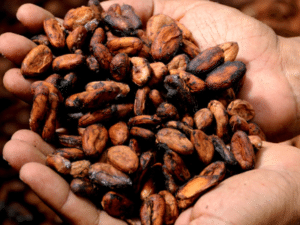 According to the World Cocoa Foundation, a typical cocoa farmer in West Africa works on a plot of no more than 3.5 hectares (or 8.7 acres) and uses income gained from cocoa to support between six and eight family members. It is estimated that more than two-thirds of cocoa farmers live below the poverty line in some African cocoa growing countries.4 Unfortunately, but not surprisingly, the effects of the pandemic have added to the burden of poverty due to increased daily living costs and farm inputs combined with a decreased world market price for chocolate.5
Sustainability Challenges
Despite the recent COVID influenced setbacks on cocoa demand and price, the overall increase in worldwide chocolate consumption in the past years has improved the price of cocoa for the farmer. But with increased demand comes the reality of production practices, climate issues and the overall sustainability of cocoa production now and for years to come. In recent years, the effects of warmer temperatures and drier weather conditions have heightened problems associated with the traditional method of planting cocoa randomly under thinned forest shade. Relying solely on the soil’s natural fertility and existing forest shade without good management practices limits productivity, the ability to control pests and nourish the soil. This has led to increased deforestation for the sake of survival.
Long term financial sustainability for farmers in these West African counties is also a reality. A recent study done in Ghana found there are significant barriers for small farmers (especially women) to enter the business of cocoa farming. The lack of available land, high production costs, increased incidence of cocoa tree disease, and income that doesn’t cover expenses all combine to make cocoa farming a difficult option. Likewise, the same barriers are limiting financial growth for large farmers. High input costs, including labor, contribute to financial instability and limited adoption of new agricultural technologies.6
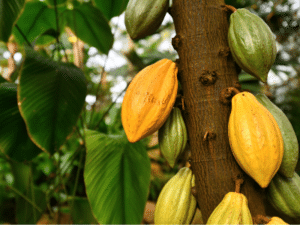 Cocoa sustainability efforts are front and center for the chocolate industry. There are several collaborative initiatives in place including the World Cocoa Foundation.3 This is a public/private initiative with members on six continents, representing 80% of the global cocoa and chocolate market. The foundation has been focused on addressing the need for a sustainable and thriving cocoa sector since the early 2000s. Issues like deforestation, child labor, and new forest development are top of mind along with pest and disease management. Like any agriculture production, cocoa production is not easy but the limitations of where cocoa is grown adds to the long-term sustainability of the product.
Our Global Bliss
The basic ingredients of any dark chocolate start with the cocoa bean as the chocolate liquor (liquid), cocoa butter and cocoa powder are derived from the bean. So, as we share our chocolate or self-indulgence this Valentine’s Day (or any day), think about the intertwined global network that created our moment of bliss. Enjoy your chocolate (in small amounts, of course) and know there’s a farmer that helped you enjoy every bite. Chocolate, like all our food, makes the world go around. Let’s show our love!
References
1. “History of Valentine’s Day,” Always a Treat by the National Confectioners Association.
2. “After a Year of Record-Setting Confectionery Sales, Valentine’s Day 2022 Will Be a Treat for Consumers and Industry Alike,” National Confectioners Association, February 3, 2022.
3. “How Many Pounds of Chocolate Do Americans Buy for Valentine’s Day?” by Carolyn Menyes, The Daily Meal, February 5, 2020.
4. “Prosperous Farmers: The World Cocoa Foundation and our members work to improve the livelihoods of cocoa farmers around the world,” World Cocoa Foundation.
5. Cocoa Barometer 2020. Published by the Cocoa Barometer Consortium. Administered by the VOICE Network. (pdf file)
6. Long-Term Change, Commercialisation Of Cocoa Farming, and Agroecosystems and Forest Rehabilitation In Ghana, Working Paper 80, January 2022, by Kojo Amanor, Joseph Yaro and Joseph Teye. Published by Agriculture Policy Research in Africa. (pdf file)