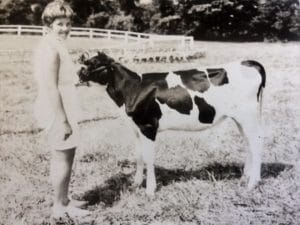
Marianne on the family dairy farm (1967)
Regardless of our childhood and how long ago it was, we have memories that bring smiles to our faces, tears to our eyes or the realization of what we thought was bad, may actually have been good. June brings those mixed emotions for me as we celebrate National Dairy Month, Father’s Day and lessons learned growing up on a dairy farm. Farming, as highlighted in headlines and photos over the past few months, has never been for the “faint of heart” and I would contend dairy farming exemplifies that statement to the max. Continuous cow care, milk price volatility, never ending jobs and neighbor acceptance all play into the reality that what some of us thought was “bad” in our youth, was actually a good foundation for life. And now, years later, it is easy to see that the lessons learned extend beyond the cow.
Scars of Youth
As a teenager, it wasn’t really cool to grow up on a farm and even though my brother and I had the advantage of being only 20 miles from Cincinnati (and 10 miles from our high school), it was a “long journey” between us and our classmates. Summers were spent “on the farm” and involvement with after-school activities just meant the calves would be bawling a little louder, demanding to be fed as you drove the car by the barn. When it was your responsibility, it was YOUR responsibility. Over the years, I’ve learned my “scars of youth” were actually building blocks for the future, shared by other “farm kid” colleagues who have graced my path along the way. Teamwork, determination, entrepreneurship and personal responsibility are common themes mentioned whether they grew up in Kentucky, Wisconsin, Maryland or any other part of the country. And they are themes that continue to resonate with 37,000 American dairy farmers today.
There is No “I” in Team
We hear the phrase “there is no ‘I’ in team” often in the world of sports, especially basketball, but this rings true in any situation. “Growing up on a dairy farm taught me the value of team work!” says Michael Dykes, CEO of the International Dairy Foods Association (and fellow Kentuckian). “All jobs had to be done twice daily seven days a week so if I didn’t do my jobs another family member had to do theirs plus mine — an added burden that you wanted to avoid if possible.” Gloria Basse, an independent ag business consultant described it as “clear expectations … As a family of four growing up in Wisconsin we all had a role and different tasks as identified by my father (the CEO) and directed by my mother (the COO). We were empowered to do our jobs as it was never an option to not milk the cows.”
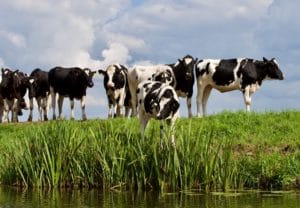 For many of us growing up in the 60s and 70s, the on-farm “team” was mainly our families. Veterinarians, feed supply stores, milk tank drivers, processors and of course, the dairy industry as a whole, made up the remaining team members, all working together to ensure that our cows were at their best to produce a quality product that we believed to be of value to the consumer. Today, the idealistic “red barn on the road” 40-cow dairy rarely exists due to the reality of economics. Dairy farms are still mainly family owned (approximately 95%) and regardless of size, team work remains at the forefront of ensuring that cows are at their winning best.
The Entrepreneurial Culture
Gloria stated it best, “the two words that come to top of mind when I think about lessons learned on the dairy farm are entrepreneurship and culture.” As she noted, there is an internal drive that is instilled to always “do it better” or to be making continuous improvement as the business world would describe it. As the volatility of milk prices and the economics of supply and demand dominate the industry, the entrepreneurial spirit has never been more important or embraced to keep dairies financially viable. From the consumer viewpoint, trying to balance headlines of “more dairy farms going out of business” with those claiming “small dairy vitality” can be confusing. As with any entrepreneurial business, a good financial plan and knowledge of the customer base is essential.
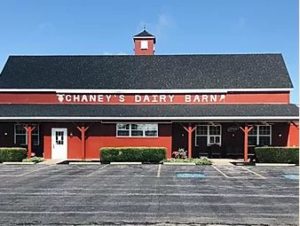 Today’s small farms (200 or less cows) are more likely to be innovators of change, transforming from selling bulk milk to processors to providing local consumers home-delivered bottled milk, or selling self-processed branded milk, homemade ice cream, cheese or yogurt at on-farm stores. Farms like South Mountain Creamery near Frederick, Maryland, Illinois-based Rolling Lawns Farm near St. Louis or Chaney’s Dairy Barn in Bowling Green, Kentucky, are all examples of families transforming their dairies to preserve generational history and provide customers with a locally sourced product. While these local dairies provide for segments of the population in their respective areas, it’s the efficiency of today’s larger farms with hundreds of cows that supply the broad base distribution of milk at an affordable price for all … but at the expense of the farmer’s bottom line. It’s a continuing challenge where dairy farmers must weigh passion for their cows and their way of life with financial realities. It’s a reality I and others know all too well.
Cows Don’t Take Vacations
Regardless of the size of herd, type of operation or milk variety produced, dairy farmers remain committed to producing milk in a safe and sustainable way 365 days a year. As fellow Kentuckian Jennifer Garrett, PhD, a food and agriculture consultant, stated, “hard work and determination” are the lessons I learned. “You’re not finished for the day until the job is done no matter how you feel … the cows must always be milked and fed with care at least twice a day. Cows don’t take vacations and neither did we.” Perhaps, that is why my colleagues and I commented that “winning trips” from organizations like 4-H were our tickets to travel and set the stage for our pre-COVID travel-laden professional careers — making up for lost time!
It’s Still About the Milk
As I reflect on my own experience and the numerous conversations I have had with farmers, consumers and colleagues over the years, it would be easy to question why farmers would want to run a dairy in an environment of economic instability, consumer misperceptions, and a plethora of alternative milk-like beverages. Thinking about my late father and dairy farmers I know today, I contend it’s still about their commitment of supplying nutritious and safe dairy products for consumer well-being, a task not taken lightly.
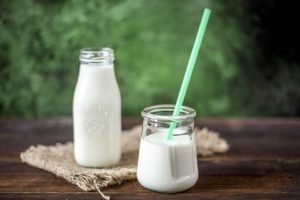 Whether the price is less than $2 a gallon (a real bargain) or over $7 a gallon, milk and milk products provide the ultimate “return on investment” for the nutrition boost they provide. Milk, unlike other alternative milk beverages provides 11 essential nutrients, including three of four nutrients identified as “nutrients of public health concern” (calcium, Vitamin D, and potassium) in the 2015 Dietary Guidelines for Americans (DGA) and recently reconfirmed by the 2020 DGA Dietary Advisory Committee. In fact, a new analysis by Rabobank found that the coronavirus pandemic has “rejuvenated the dairy category” as consumers globally turn back to a “trusted, nutritious product.” 1
Perseverance Prevails
“Nothing worth doing comes easy” is a quote that comes to mind when I think about my father’s passion to keep a dairy operation going for 51 years, or see today’s dairies donating gallons of milk to food banks during difficult times, or observe the commitment to innovation by farm families.
Regardless of whether farms are large or small and whether they ship milk to a processor or door steps, the milk and dairy products we have available to us today are due to the perseverance of the farmer and the care of their cows.. So celebrate National Dairy Month by thanking a dairy farmer and buying some milk!
References:
- “Analysis: Dairy ‘rejuvenated’ but oversupplied,” Agri-Pulse, June 17, 2020.
Resources:
- Special thanks to my “farm kid” colleagues Michael Dykes, Gloria Basse, Jennifer Garrett and Lois Skeen for their valuable insights.
- “All About the Cow,” Laurie Bedford, Successful Farming, June 2020.
- “June is National Dairy Month: Let’s Recognize Dairy’s Role in Fighting Food Insecurity,” Michelle Albee Matto, International Dairy Foods Association, June 1, 2020.