
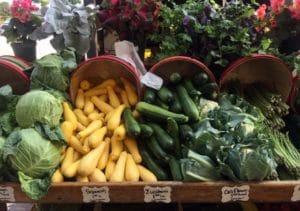
 Visions of bright red tomatoes, sweet corn in the husk and zucchini of all shapes and sizes “dance in our heads” and on our plates as the farmers’ market season is in full swing across most of our country. In fact, the first week of August was designated National Farmers’ Market Week.1 I am a big fan of farmers’ markets and never miss an opportunity to visit one wherever I am! They are the connection to local food production and a window into the local community.
Growing up in the 1960s and 70s, farmers’ markets were unimaginable in Kentucky as “everyone” grew a garden. In fact, with the exception of an occasional orchard visit, we ate what we grew when it came to seasonal produce. Even though the return of the garden or a few tomato plants (or kale for me!) in the backyard has exploded this year due to our current COVID pandemic, farmers’ markets (or CSAs) in our respective towns and cities remain more than our source of “fresh.” Beyond the produce, food and wares, they are a reflection of resiliency and community spirit and symbolic of sustainability in action.
Defining the Market
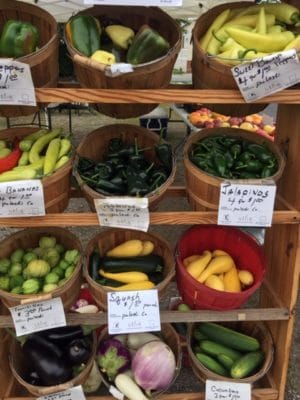 The number of farmers’ markets in the United States has grown from just under 2,000 in 1994 to approximately 8,800 today based on those registered in the USDA Farmers’ Market Directory. With less than 2% of our population connected to a farm, farmers’ markets create a win-win for communities by connecting the “farmer to the consumer” and creating opportunities for small and younger farmers to market niche products from microgreens and grass-fed beef to artisan breads and pastries. So, what is a farmer’s market? By USDA definitions, a farmer’s market must consist of two or more farm vendors selling agricultural products directly to customers at a common, recurrent physical location.2
CSAs (community supported agriculture) or on-farm markets may be extensions of a farmer’s market vendor but are defined as separate entities. CSAs, approximately 900 strong, are farms or a network/association of multiple farms that offer consumers regular (usually weekly) deliveries of locally-grown farm products during one or more harvest season(s) on a subscription or membership basis.3 On-farm markets must be managed by a single farm operator that sells agricultural and/or horticultural products directly to consumers from a location on their farm property or on property adjacent to that farm. There are approximately 1,600 on-farm markets in the United States.4
The Economic Factor
With the continual growth of farmers’ markets across the country, there is a growing body of research that points to the economic benefits of farm-direct marketing. A Sacramento, California, based study showed that, “for every dollar of sales, direct marketers are generating twice as much economic activity within the region, as compared to producers who are not involved in direct marketing.”5
 Locally, Jim Gilles III of Hill View Farms Meats has stated that visibility at the Owensboro Regional Farmers’ Market has contributed significantly to the growth of his year-round sales at his on-farm market. His personal experience validates what earlier studies have reported across the country in past years. For example, those studies reported that 80% of farmers’ market vendors in Iowa, New York and California said farmers’ markets offered them a greater opportunity for business development than any other possible marketing outlet.6
In addition to direct cash sales, the acceptance of USDA-based programs like SNAP, WIC and Senior Program benefits by markets and farmers has increased significantly over the past eight years. Based on a 2017 USDA report, the amount of SNAP benefits redeemed at farmers’ markets increased nearly 35.2% from 2012 ($16.5 million) to 2017 ($22.4 million) — a benefit for the farmer and most of all, the recipients.7
Preservation of the Land and Our Trust
With the reality that the average age of the U.S. farmer continues to rise (now 59.4 years), farmers’ markets can serve as incubators for new enterprises and a venue for younger farmers to build diversity within an existing farming operation or transition to a new crop. For example, Gilles took the opportunity to expand his family’s cow-calf operation from an initial offering of “sides of beef” to a year-round consumer-facing supplier of locally grown meat and poultry. Suzanne Cecil White, a former teacher who has followed in the footsteps of her father — a pioneer in growing consumer-based crops in Owensboro — has developed a year-round supply chain of seasonal produce and plants. These are two of the hundreds of examples from across the country that reflect the innovation and commitment to preserve farmland for future generations.
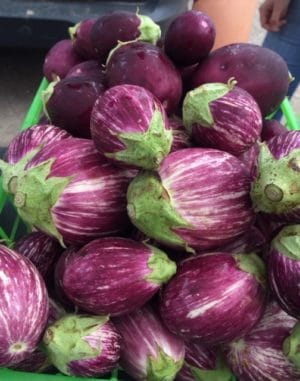 As consumers, we want to know where our food comes from and how it’s produced. Meeting the producers face to face gives us the opportunity to understand their story and efforts behind the rows of eggplants or tomatoes waiting for purchase. Produce and meat products don’t appear without human intervention. According to Cecil White, with Cecil Farms Produce, it takes almost 80 hours of labor to be ready for a Saturday morning farmers’ market. (And that’s just the hours to harvest AFTER post production.) With the variety and quantity of produce offered during the market, six workers will pick for 12 hours on a Friday followed by the evening vendor preparation and a 5:30 a.m. Saturday start. For a meat vendor like Gilles, the weekly preparation time for a farmers’ market is less than four hours but the preparation begins at least a year and half in advance to achieve the desired meat quality. For beef, it’s the breeding of cattle for desired marbling, while for chicken, it’s the selection of a breed known for egg production or meat quality. Regardless of the desired traits for either animal, a nutritionally planned diet during their life cycle must be planned and fed. Once animals are ready for the consumer market, only USDA certified meat processors are used to ensure the highest food safety standards are followed. This year, like all meat processors big or small, COVID-19 has impacted production. Even though the pandemic has created a larger local base for suppliers, operations like Hill View Farms Meats have still experienced processing delays due to increased statewide demand on regional meat processing operations.8
Resiliency
With the disruption of the food distribution system over the past few months due to COVID-19, local farmers’ markets, CSAs and on-farm markets have seen a surge of local customers’ support, bringing a positive impact to their respective communities. But, like any entity, opening of seasonal farmers’ markets didn’t come without adjustments. Permanent pavilion structures stand empty, yielding to free-standing vendor tents in parking lots with single entry and exit. Implementation of state or local mask requirements with six-feet distance markings are evident throughout most markets. Cashless transactions, produce pre-orders, no-touch buying and often, long lines have become the accepted norm rather than frustration whether buying in Kentucky, Colorado or wherever one may shop.
Resiliency, like sustainability, is the core existence of any farmer or farming operation, and this year has been a challenge. As consumers, we have experienced disruptions as well, adapting to virtual communications and limited social interactions. But there is one constant that remains: the access to locally grown seasonal food thanks to the commitment of our farmers and producers. Take the time to support farmers’ markets in your community or whatever community you visit. We all share in the success when our food systems succeed. To find a farmers’ market, CSA or on-farm store, check out the links listed below.
References
1. National Farmers Market Week, Farmers Market Coalition.
2. Local Food Directories: Farmers Market Directory, U.S. Department of Agriculture, Agriculture Marketing Services.
3. Local Food Directories: Community Supported Agriculture (CSA) Directory, U.S. Department of Agriculture, Agriculture Marketing Services.
4. Local Food Directories: On-Farm Directory, U.S. Department of Agriculture, Agriculture Marketing Services.
5. “Economic Impact of Local Food Producers in the Sacramento Region,” University of California Agricultural and Natural Resources and UC Davis, Spring 2016.
6. “Entrepreneurial outcomes and enterprise size in US retail farmers’ markets,” American Journal of Alternative Agriculture, by Gail W. Feenstra, Christopher C. Lewis, C. Clare Hinrichs, Gilbert W. Gillespie and Duncan Hilchey, Volume 18, Issue 1, March 2003.
7. Supplemental Nutrition Assistance Program (SNAP), Farmers Market Coalition
8. Will the “New Normal” Become Normal in Our Quest for Food?, The AgriNutrition Edge Report, by Marianne Smith Edge, May 14, 2020.